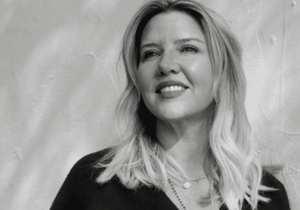
The Wonder of Woman: Christine Marie Mason on the Intelligence of the Female Body
What if the most astonishing intelligence in your life is the one you woke up in this morning?
at the base of her throat silence collects before she speaks.
she tilts toward what moves her — moans, cries out, sings alive —
and the world tilts too
Wonder of Woman
Something astonishing is happening right now, in the body you woke up in this morning. Without your instruction, without your management, without a single conscious thought from you, your body is doing ten thousand things simultaneously. Filtering light through the lens of your eye and converting it to image. Orchestrating the sixty trillion cells of you into a single coherent being. Regulating temperature to within fractions of a degree. Listening at a cellular level to the emotional state of every person in the room. Breathing. Dreaming even when you think you are awake. Carrying, in the spiral architecture of your DNA, four billion years of unbroken life.
This is what you are. Before you are anything else, before you are your name, your history, your accomplishments, or your wounds, you are this. An incomprehensible feat of living intelligence, walking around in the world as if it were ordinary.
It’s not ordinary. It’s miraculous.
And in a woman's body, in particular, something is happening that we have barely begun to find language for. International Women's Day has a history of looking clearly at what has been done to women, what has been taken from them, and what still needs to change. That gaze is necessary, AND… we will have a much better chance of getting there if we start somewhere else: in wonder.
In the specific, embodied, staggering wonder of what it actually is to be a woman. Felt from the inside, known in the bones, celebrated not as consolation for difficulty but as a simple fact. In the deep knowing of our own worth and deserving.
I. The Body That Knows
The female body reads the room before the mind has registered that a room exists. It knows when something is wrong in a relationship — not as a thought, but as a shift in the chest, a subtle contraction in the belly — weeks or months before the knowledge surfaces into language. It responds to the grief of another person with a physiological change in its own chemistry. It dreams the things the waking mind cannot afford to know. It carries the quality of an encounter in the body long after the encounter has ended — holding what was true about it when the social performance might have said otherwise.
This isn’t a metaphor. The female nervous system is, on average, more finely calibrated for social and emotional perception than the male — more mirror neurons, denser interoceptive pathways, a more elaborate apparatus for reading the interior states of others. What has been called intuition is, in significant part, the output of a perceptual system so sophisticated that it outpaces conscious processing. The body knows. It has been knowing all along.
And it knows its own interior with a specificity that has no equivalent in ordinary language. The monthly cycle — which our culture has conspired to treat as an inconvenience — is in fact a complete epistemological system. Each phase brings a different mode of intelligence online. The inward, liminal knowing of the premenstrual days. The expansive, connective clarity that follows. The generative, outward energy of ovulation. The deep, dreaming, truth-telling pull toward descent. A woman who learns to read these phases is not managing a biological inconvenience. She is working with a rotating compass that orients differently each week, pointing toward different kinds of truth.
The body that bleeds is the body that is in conversation with time in a way that linear, clock-measured culture has no frame for. It is a body that knows endings and beginnings not as concepts but as physical events, recurring, unchosen, profound. Every month, a small death and a small resurrection. The mystics spend lifetimes pursuing the understanding that this body enacts automatically.
When we call this inconvenient, we are not just being ungrateful. We are declining an inheritance.
II. The Force That Generates
In the understanding that has shaped my own practice and life, Shakti is not a metaphor for female energy. Shakti is the name for the creative power of the universe itself — the force that moves through all living things, the pulse that turns potential into form, the energy without which nothing comes into being at all.
And Shakti is understood, in this lineage, as feminine.
Not because women are the only ones who carry her. Every person contains Shakti — the masculine principle, Shiva, is her complement, still and aware of her dynamic and generative. But the feminine is the movement. The feminine is the force. The still point of awareness that Shiva represents would remain forever unmanifest without the creative energy of Shakti to bring it into being. Nothing exists — not a single thing in the material or immaterial world — without her.
Sit with that for a moment. Not as religious doctrine but as an orientation: the generative principle of the cosmos is feminine.
Women generate. This is not only about biological reproduction, though the fact that the human body can build another human body from scratch — from a single cell, in darkness, without instruction — is itself so extraordinary it should stop us in our tracks every time we think about it. A woman's body builds eyes. It builds a nervous system. It builds the architecture of a brain that will one day wonder about its own existence. It does this from nothing, in nine months, while also holding down a job and dreaming at night and navigating the ordinary complexity of a human life.
But generation is not only biological. Women generate culture, language, memory, meaning, relationship. They are disproportionately the keepers of the stories — of families, of communities, of the informal histories that never make the official record but without which there would be no record at all. The first songs sung to children, the rituals of grief and celebration, the transmission of what it means to be human to the next person who has to figure that out — these have lived, predominantly, in women's hands.
Generation is also the daily, unremarked-upon labor of making life feel like something worth living. The meal that is also an act of love. The home that is also a held space. The conversation that metabolizes what was previously unmetabolizable. Women do this constantly, often invisibly, in a form of creative work the world has never adequately named or honored — partly because it doesn't produce a product, and partly because the world is still working with an impoverished definition of what creativity is.
Shakti generates because she cannot not generate. It is her nature. It is the nature of this force, showing up in a body, living a life, touching everything she touches and leaving it changed.
III. The Long Memory
There is something else a woman's body carries, and it runs deeper than one lifetime.
The egg that became you was formed in your mother's ovary while she was still inside your grandmother's womb. Three generations, touching in a single moment. Your grandmother held you, in a sense, before she had ever met your mother. This is not poetry. It is biology. And it means that the experiences of your grandmother's pregnancy — what she felt, what she feared, what moved her — were present in the cellular environment in which your mother's eggs, including the one that became you, were being formed.
The field of epigenetics is only beginning to measure what women have always known in their bodies: that we carry the lives of those who came before us. Not as abstraction or sentiment, but as literal biological inheritance. Trauma that was not metabolized by one generation is passed to the next in the architecture of gene expression. And so is resilience. And so is love. And so, in ways science has not yet developed instruments delicate enough to measure, is wisdom.
When a woman has a knowing she cannot explain — a bodily sense of something, a recognition that arrives without evidence, a pull toward or away from something that turns out, in time, to have been exactly right — she is not being irrational. She may be drawing on a database of human experience that stretches back further than she can consciously reach. The body keeps a record the mind does not have access to.
The long memory is also cyclical. Women's bodies move with the moon, with the seasons, with the rhythms of dark and light in ways that men's bodies, running on a twenty-four-hour hormonal clock, do not. This is not hierarchy — it is difference. But it means women have a particular attunement to time that is not linear. To the return. To the wheel. To the understanding that nothing is ever entirely over, that what dies comes back changed, that endings and beginnings are the same event seen from different angles.
The ancestors move through a woman. In her hands when they do what her grandmother's hands did. In the lullaby that arrives unbidden, a melody she did not learn consciously but somehow knows. In the way she tends the dying or the newborn, entering those threshold spaces with a groundedness that surprises even her. She has been here before. The women who came before her were here before. And something in her body has not forgotten.
This is the inheritance that has been most consistently suppressed and most consistently survived. You can disconnect a woman from the history of her lineage, from the land, from the ritual practices that carried this knowledge. You cannot disconnect her from her own body. The long memory lives there, available to anyone willing to listen.
Consider what it means to walk through the world in this form.
A body that is an instrument of perception so refined it registers the emotional weather of a room before the mind has put on its coat. A force that generates — life, meaning, culture, beauty, relation — not as effort but as nature. A memory that runs back through every woman who ever lived, carried in the spiral architecture of the cells, available in the wordless knowing of the body.
This is not a consolation prize. This is not the soft compensation offered in place of the harder things. This is the actual inheritance. The real one. The one that was never successfully taken, though the attempt has been sustained and thorough.
There is a way of moving through a day — through an ordinary Tuesday, through a difficult meeting, through a moment of grief or beauty or unexpected joy — in which all of this is present. In which the body is not a vehicle to be managed but a source of continuous intelligence. In which the force that moves through you is recognized as the same force that moves through everything. In which the women behind you are not ghosts but companions, their knowing available to you in the very cells that make you who you are.
That way of moving is not an achievement. It is a return. It is what is already here, underneath everything that was laid on top.
The question International Women's Day might begin with — before the accounting, before the advocacy, before the necessary and unfinished work of justice — is simply this:
Do you know who and what you are?
Not as rhetorical provocation. As genuine question. As the thing worth sitting with on a morning like this one, in the body you woke up in, which has been doing ten thousand astonishing things since before you opened your eyes.
The world that becomes possible when women know what they are — not as an idea but in the bones, in the blood, in the lived certainty of it — is not a world any of us have fully seen yet.
I can glimpse it in my mind’s eye, and it is beautiful, deep and wise and wonderful.
Christine Marie Mason
Shop what’s in this story

Frequently asked
Is it true that the egg that became me formed while my mother was still in my grandmother's womb?
What does it mean that the menstrual cycle has 'phases,' and why does each feel different?
Can experiences really be passed down through generations in the body?
How can I begin to feel more of this 'body intelligence' in daily life?
References
- Oogenesis — Egg Development, Maturation & Fertilization— Encyclopaedia Britannica
- Menstrual Cycle (Normal Menstruation): Overview & Phases— Cleveland Clinic
- Transgenerational Epigenetic Inheritance of Traumatic Experience in Mammals— NIH / PMC






Related Articles