How a Flower Gets Into Your Body
Herbs enter the body by many routes. Pharmacology now maps why those choices worked. Here are five we work with.
Orally, as a Tea
Hot water extracts chamomile's water-soluble compounds, chief among them the flavonoid apigenin. Absorbed through the gut wall, they pass through the liver's first-pass metabolism and then circulate through the whole body. In laboratory studies, apigenin binds the benzodiazepine site of GABA-A receptors, the target of many calming medicines. Chamomile also relaxes smooth muscle in lab models, consistent with its long use for an unsettled gut and menstrual cramps. A 2016 trial in postpartum women found that two weeks of daily chamomile tea improved sleep quality. Bisabolol, the flower's anti-inflammatory sesquiterpene, is lipophilic and mostly stays in the strainer. For the cup before bed, we carry the Sleep blend from our partners at Art of Tea, chamomile steeped with lemon balm and valerian.
Orally, as Steam
Chamomile's volatile oils rise with the steam. Odor molecules bind receptors in the olfactory epithelium, which signal through the olfactory bulb straight into the limbic system, where emotion and memory are processed. Smell is the one sense that reaches those regions without first relaying through the thalamus, which is why a scent can shift your state before a thought forms. A fraction of the volatiles also absorbs across the lungs.
Through the skin, as a Soak
Soaking in mineral water is one of humanity's oldest therapies, from Roman thermae and Japanese onsen to the Dead Sea and the sulfur springs found on every continent. Science has caught up with much of what bathers knew. Minerals dissolve fully in water, which makes a bath their natural vehicle, and they act first on the skin itself. In a controlled study, volunteers with dry skin soaked one forearm daily in a magnesium-rich Dead Sea salt solution and the other in tap water. After six weeks the salt-soaked arm had a stronger skin barrier and better hydration, with less roughness and redness. Twenty minutes in warm water also raises skin temperature and blood flow and swells the stratum corneum, opening it. How much magnesium travels on into the bloodstream remains an active research question. Meanwhile the steam brings the flowers' volatile oils to you with every breath, and oil-soluble compounds such as bisabolol float on the surface and settle onto your skin as a fine film.
Through the Skin, as Creams, Poultices and Potions
The stratum corneum is the body's main barrier: some fifteen to twenty layers of flattened, keratin-filled cells set in a lipid matrix of ceramides, cholesterol and free fatty acids. How far a botanical travels through it depends on four variables.
Size. Penetration falls off sharply above roughly 500 daltons. Bisabolol, at about 222, sits well under that line.
Partition. A molecule must be lipophilic enough to enter the lipid matrix and hydrophilic enough to move on into the watery living epidermis beneath. Moderately lipophilic compounds travel farthest. Bisabolol is studied as a penetration enhancer, and research suggests it loosens the packing of those lipids, easing the way for the botanicals formulated with it.
Preparation. Hydration swells the stratum corneum and raises its permeability. Warmth and massage increase local blood flow, which carries absorbed compounds away and keeps the concentration gradient working. The old habit of a warm compress before the salve is sound pharmacology.
Site. Permeability tracks the thickness and structure of the skin. The soles are among the least permeable surfaces of the body. Vulvar skin is measurably more permeable than forearm skin, and the non-keratinized tissue of the inner vestibule more permeable still.
Most topical botanicals act in the epidermis and upper dermis, where irritation and inflammation play out. A smaller fraction reaches the dermal capillaries and enters circulation, bypassing the gut and first-pass metabolism entirely.
Through the Mucosa: Vaginal or Rectal Insertion
This is the territory of suppositories, or enemas, or gels.
The linings of the vagina and rectum are mucous membranes: thin, moist tissue without the skin's keratin barrier, with a rich blood supply just beneath. What's placed there absorbs quickly, and much of it skips the liver's first pass, which is why clinicians use these routes for some medicines. That openness asks for discernment. The vagina is a self-cleaning ecosystem with its own pH and microbiome, so anything that goes inside should be made for it. Creams and oils formulated for skin, Soothe included, belong on the outside.
They often work best in sequence or layered. The soak warms the skin and bathes it in minerals, and the cream, applied while the skin is still damp, delivers.
Soothe is a Rich Cream of Chamomile, Mint, Aloe, Arnica... all the Magic Plants!
Soothe works for intimate care, and the whole body. Smooth a little over razor burn along the bikini line, inner thighs chafed from a long run, a bug bite, or the outer folds after lovemaking that ran long. Apply it after a warm bath or shower, while the skin is still damp, and you put preparation on your side.
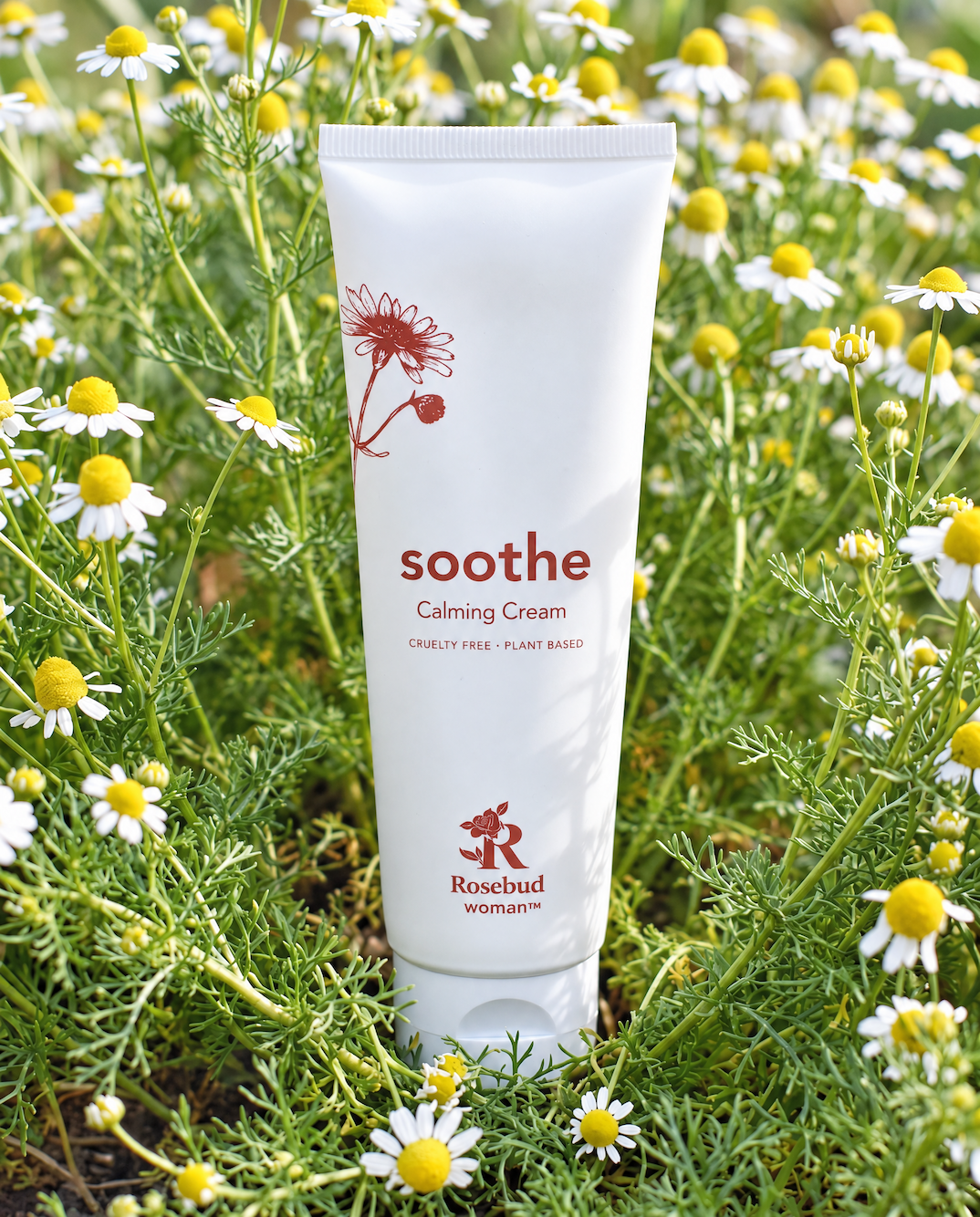
Shop Soothe Calming Cream · $40
Chamomile belongs to the daisy family, so if ragweed or daisies make you sneeze, patch test first. If you're pregnant or take blood thinners, ask your provider before drinking chamomile tea daily. The Sleep blend contains valerian, so save it for bedtime and check with your provider if you take sedatives. If you're pregnant, or have a thyroid or liver condition, talk with your provider before taking ashwagandha by mouth. If irritation lasts more than a few days, or comes with unusual discharge or odor, see your provider.
Sources
- Chang SM, Chen CH. Effects of an intervention with drinking chamomile tea on sleep quality and depression in sleep disturbed postnatal women. J Adv Nurs. 2016;72(2):306–315.
- Proksch E, Nissen HP, Bremgartner M, Urquhart C. Bathing in a magnesium-rich Dead Sea salt solution improves skin barrier function, enhances skin hydration, and reduces inflammation in atopic dry skin. Int J Dermatol. 2005;44(2):151–157.
- Bos JD, Meinardi MM. The 500 Dalton rule for the skin penetration of chemical compounds and drugs. Exp Dermatol. 2000;9(3):165–169.
- Britz MB, Maibach HI, Anjo DM. Human percutaneous penetration of hydrocortisone: the vulva. Arch Dermatol Res. 1980;267(3):313–316.






Related Articles