Your Intimate Life and Women's Health Are on the Ballot

Sent to our list on October 16, 2026, ahead of the November 3 election.
Mail ballots are arriving now, and Election Day is Tuesday, November 3. Every seat in the U.S. House and about a third of the Senate are up, along with state measures that touch women's health directly. Here is what's on the agenda for women's health.
In Congress: midlife health
The Advancing Menopause Care and Mid-Life Women's Health Act is bipartisan. Senators Patty Murray and Lisa Murkowski reintroduced it in April, with a House companion (H.R. 9090) in June. It would authorize $275 million over five years for menopause research and clinician training, and the American College of Obstetricians and Gynecologists has endorsed it. The Congress you elect decides whether it moves.
Context worth knowing: the FDA updated safety labeling on several menopause hormone therapies this year, changing how risks are communicated.
At the FDA and in the courts: mifepristone
Mifepristone, the first pill in a medication abortion and also used in miscarriage care, can currently be prescribed by telehealth and dispensed by mail or pharmacy under rules the FDA adopted in 2023. In May, the Supreme Court kept that access in place while litigation continues.
The FDA is now running a safety study and a review of those rules. In an October 7 court filing, the agency said it expects study results by mid-December and plans to finish its review and report by March 2027. Pending petitions ask it to bring back the in-person dispensing requirement. A Louisiana lawsuit challenging mail access is on hold until the review is done, and two other federal courts have ordered the FDA to reconsider the 2023 changes.
These steps appear in Project 2025, the Heritage Foundation's 2023 policy blueprint written for an incoming conservative administration. Its health chapter, by former HHS official Roger Severino, urges the FDA to withdraw its 2000 approval of mifepristone and, as an interim step, to reverse the guidance that allows telehealth prescribing. The blueprint also proposes enforcing the 1873 Comstock Act against mailing abortion pills, and having the CDC withhold funds from states that don't report.
This decision belongs to the FDA, part of the executive branch. Congress oversees the agency and can legislate on drug approval rules.
Your health data
Reproductive health records. In 2024, federal regulators added HIPAA protections that limited how providers could share records about reproductive care. A federal court struck those provisions down nationwide in 2025, and the appeal was dismissed.
Apps. HIPAA generally covers health providers and insurers. Most period-tracking, fertility and wellness apps sit outside it, so their own privacy policies and your state's laws decide what happens to your data. Read where your cycle data is stored before you log the next one.
Federal data and AI contractors. The data analytics firm Palantir has held federal health contracts for years, including a $90 million HHS contract vehicle announced in 2022 to unify agency datasets. This year, Medicaid data was shared with immigration authorities and passed to Palantir. A federal judge paused that data sharing for immigration enforcement in May. The open question it raises is who can see the health records government agencies already hold. Congress sets those rules.
At the United Nations
In March, the UN Commission on the Status of Women closed its 70th session, themed on access to justice for women and girls. Its Agreed Conclusions are nonbinding recommendations. They call on countries to review discriminatory laws on child marriage, family law and property rights, and to strengthen protections against violence toward women and girls online and offline. For nearly seven decades the commission had adopted its conclusions by consensus. This year it took a vote, and the United States was the only country to vote no. The U.S. objected to the document's language on abortion rights, artificial intelligence regulation and what the White House called "gender ideology"; its proposed amendments were rejected. U.S. positions at the UN are set by the executive branch, and the Senate confirms the ambassador.
Already law, taking effect: your coverage
Medicaid. Medicaid covers 18% of U.S. women ages 19 to 64. Starting January 1, 2027, adults in the Medicaid expansion group must meet work or community-engagement requirements, or qualify for an exemption, to keep coverage. Pregnant and postpartum women are exempt, and so are parents of children under 14. Most women on Medicaid meet the requirements or qualify for an exemption; the risk is the reporting paperwork. If you're enrolled, ask your state Medicaid office now what you'll need to report.
ACA Marketplace. The enhanced premium tax credits expired at the end of 2025. Marketplace enrollment fell this year for the first time in seven years, and subsidized enrollees who kept the same plan saw their premium payments rise 114% on average. Whether to restore those credits sits with Congress.
On state ballots: reproductive health
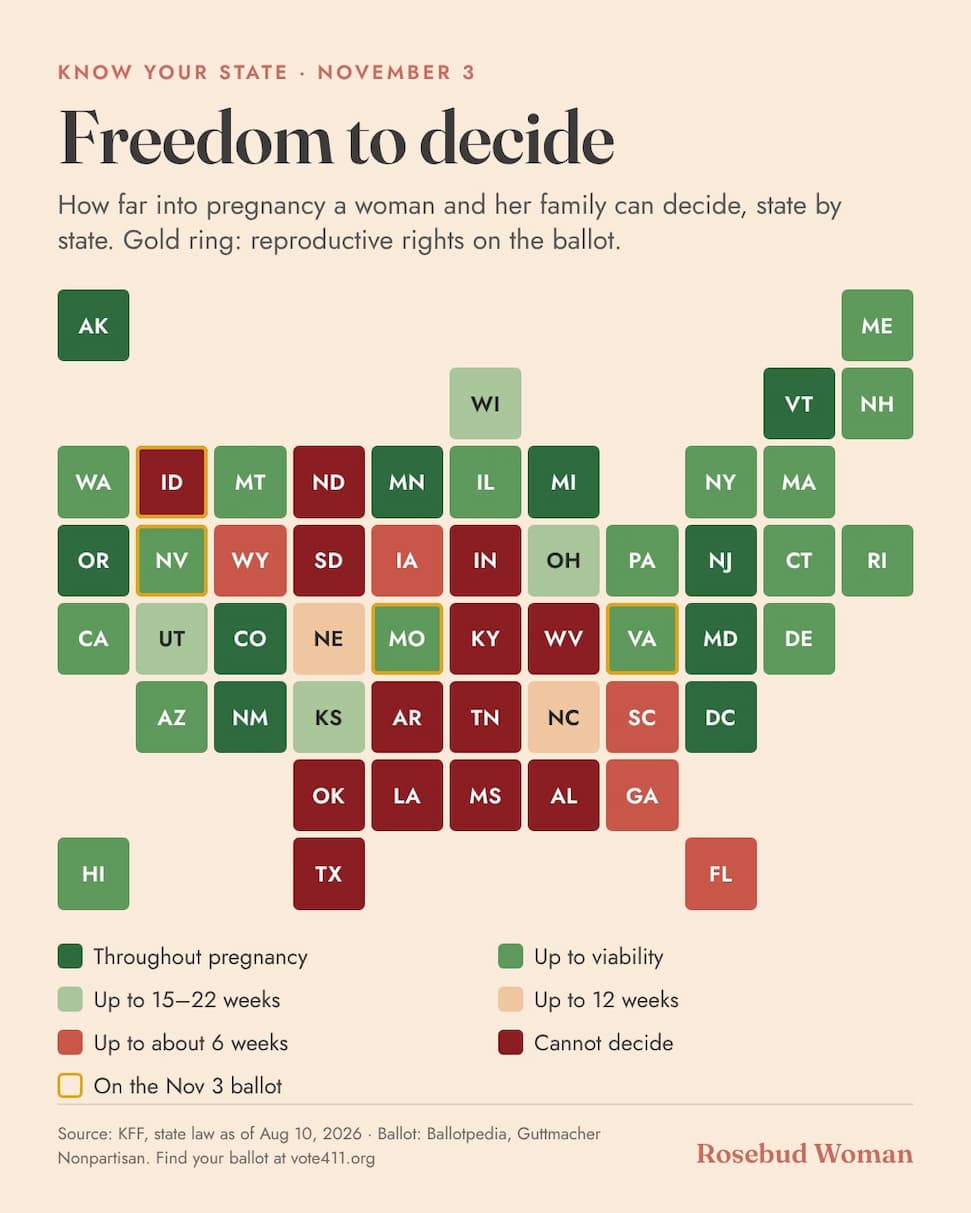
Missouri · Amendment 3 (placed on the ballot by the legislature)
A yes vote repeals the reproductive-rights amendment Missouri voters approved in 2024, allows the state to prohibit most abortions with exceptions for the life of the mother, fatal fetal anomalies and some cases of rape and incest, and adds a constitutional ban on gender-transition care for minors. A no vote keeps the 2024 amendment in place.
Nevada · Reproductive rights amendment (second vote)
Nevada voters approved this amendment in 2024. A constitutional amendment there must pass in two consecutive elections, so it returns. A yes vote writes the right to abortion into the state constitution and bars penalizing patients or those who help them. A no vote leaves it out of the constitution.
Virginia · Right to Reproductive Freedom Amendment (referred by the legislature)
A yes vote amends the Virginia Constitution to establish a right to reproductive freedom. A no vote leaves the constitution unchanged.
Idaho · Reproductive Freedom and Privacy Act (citizen initiative, state law)
A yes vote establishes a right to make one's own decisions on pregnancy, contraception, fertility treatment, prenatal and postpartum care, miscarriage care and abortion. A no vote keeps current law.
In the federal budget: family planning
Planned Parenthood and Medicaid. The 2025 budget law barred Medicaid payments to Planned Parenthood for one year. That provision expired July 4, 2026, and payments resumed. Some lawmakers are pressing to renew it in another budget bill before the election; its prospects are unclear.
Title X, the federal family planning program, funds contraception, cancer screenings and STI testing at clinics nationwide. As of May 2026, 247 Planned Parenthood clinics in 29 states took part, down from 297 in 34 states and DC a year earlier. The President's 2027 budget again includes no Title X funding, and the program's newest funding notice shifts emphasis toward fertility-awareness methods and family formation. At least eleven states now use their own funds to fill gaps. Congress writes the budget.
Close to home
Many counties carry their own measures on child care, paid leave and local health funding. For nonpartisan guides to the candidates in your state, see guides.vote. To see your exact ballot, local measures included, use vote411.org (League of Women Voters, nonpartisan) or ballotpedia.org.
Sources: Missouri Independent, May 2026 · St. Louis Public Radio · Ballotpedia · Axios · KFF · Guttmacher, Oct 2026 (ballot status) · States Newsroom / Alaska Beacon, Sep 2026 · La Voce di New York, Sep 2026 · Rep. Clarke release · H.R. 9090 summary · FDA status report, Louisiana v. FDA, Oct 7, 2026 · Spectrum News, June 2026 · Fox News, April 2026 · The Guardian via AOL · States Newsroom on Comstock · KFF update · Bloomberg Government · The Evangelist, July 2026 · JURIST, March 2026 · Media Bias/Fact Check, Sep 2026 · Haynes Boone · NPR via CT Public, July 2026 · Palantir HHS contract, 2022 · KFF, Medicaid Coverage for Women, Aug 2026 · GoodRx on exemptions · KFF on enrollment and premiums · KFF policy research
Rosebud Woman does not endorse candidates, parties or positions on ballot measures.






Related Articles