The Milk Is Continual Communication
Milk made at two in the morning is chemically different from milk made at noon. The night version carries melatonin and more of the tryptophan the body builds it from. The day version runs higher in cortisol and in the amino acids associated with alertness. A newborn arrives with no circadian rhythm of her own, and her mother's milk hands her the beginning of one, feed by feed, in the dark.
Part one traced the donut back to the breast: fat and sugar arriving together, the only pairing of its kind in nature, reverse-engineered into shelf-stable form by people with spreadsheets. That is the part a formula can copy. A formula holds its numbers still. Milk keeps writing.
It changes inside a single nursing session
The milk at the start of a feed runs watery and higher in lactose. The milk at the end runs several times fattier as the fat globules that cling inside the ducts finally move. A baby who wants a drink gets a drink. A baby who stays latched gets the cream. Mothers read this without a lab, which is why a woman can tell you her baby is cluster feeding for calories tonight rather than comfort.
It changes across the weeks too. Colostrum comes first, thick and gold and closer to an immune transfusion than a meal, heavy with antibody and produced in teaspoons rather than ounces. Over several days it thins and whitens into transitional milk, then into mature milk. A woman who delivers at twenty-six weeks makes milk measurably different from the milk of a woman who delivers at forty, tuned to a smaller gut with more urgent needs.
It changes because of what is happening in the house
When a mother's gut meets a pathogen, plasma cells from her intestinal lymph tissue migrate through her circulation to her mammary gland, drawn by a chemical signal the breast itself produces. Those cells set up in the breast and start making antibody against the specific organism she met. The antibody enters the milk in a secretory form built to survive stomach acid, reaches the infant's gut intact, and blocks that organism from attaching to the gut wall.
Researchers call it the entero-mammary pathway. Mother and baby share a kitchen, a bed and an air supply, so whatever she encounters is what he is about to encounter. Her body reads the room and updates the supply. By ten days of age, roughly eighty percent of the bacteria in a breastfed infant's gut are bound by antibodies that came from his mother's milk.
The same responsiveness shows up in the cell count. When either mother or infant is fighting an infection, the leukocytes in her milk climb, sometimes steeply, and settle back down once the illness passes.
And roughly two hundred human milk oligosaccharides ride along that the infant cannot digest at all. Those sugars are not food for the baby. They are food for the bacteria the baby is trying to grow, laid down as a preferred substrate for the strains that belong there.
The question of the backwash
During suckling, some infant saliva travels back up into the nipple and into the ducts. Ultrasound imaging documented this retrograde flow in 2004. Researchers have wondered since whether that saliva carries information about the infant's state into the gland, prompting a made-to-order response. A 2022 mouse study gave the idea real experimental weight. In humans it remains a hypothesis, which is the honest word for it.
What is documented in humans is that infant saliva and milk react on contact. The saliva brings one set of enzymes, the milk brings the substrate, and together they generate antimicrobial compounds that neither produces alone, shaping which organisms settle into the newborn's mouth and gut. The exchange runs both directions, which is a strange thing to sit with while holding a baby.
Nothing in a jar does this. Every product ever made, including every product we make, is a fixed formula meeting a moving body, and the moving body is doing the more sophisticated work.
Send this to the people in your life with a baby at the breast, and to the ones deciding how to feed. What a woman is running while she nurses deserves to be understood by the household around her.
Where this lands in your body
Your skin works on the same principle. It reads conditions and adjusts, all day, without asking you. Oil production rises and falls with the season and with your cycle. The barrier repairs itself overnight. The tissue across your belly and breasts spent nine months being remodeled by hormones and then spent the years after that renegotiating.
That tissue has a long memory. The belly skin that stretched and came back with a different texture. The silvery lines along the hips and the outer breast where the dermis tore and healed. The scar across the lower abdomen, still slightly numb at the edges years later. The breast that emptied and refilled a thousand times and then, at weaning, went quiet.
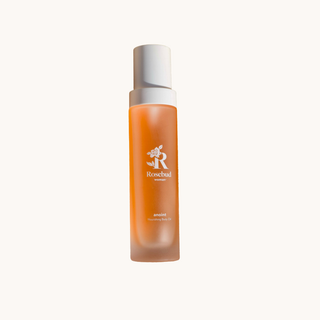
Anoint is the oil for that whole territory. Squalane close enough to your own sebum that it sinks in rather than sitting on top. Schisandra for elasticity and firmness. Centella asiatica, which has a long clinical history in the appearance of scars and stretch marks. Rosehip and suma in an organic base.
Here is the pass, and give it three full minutes. Two pumps into your hands. Start at the sternum and work out along the ribs under each breast, following the underside fold. Take the outer curve of the breast toward the armpit. Then down the flanks and across the belly in slow circles, going with the direction of the hair. Spend real time on any scar, working across the line rather than along it, until the tissue warms and gives. Finish at the hip bones.
Do it after a shower while the skin is still damp, and do it in enough light to actually look at what your hands are on. This is the body that ran the most responsive feeding system on earth, or carried a pregnancy, or did neither and deserves the oil regardless.
Your tissue is still reading conditions and adjusting. Give it something to work with.
Supply concerns, pain with latch, and anything that looks like mastitis belong with an IBCLC lactation consultant or your provider, and quickly. A new lump, dimpling, skin change or unexplained discharge belongs with a clinician. Oil is care, and care is not screening.
Sources
- Circadian composition: Cubero et al. on melatonin and tryptophan in night milk; Italianer et al., Nutrients 2020, review of circadian variation in human milk.
- Foremilk / hindmilk fat gradient: Ballard & Morrow, Pediatric Clinics of North America 2013.
- Preterm vs term milk composition: Gidrewicz & Fenton, BMC Pediatrics 2014.
- Entero-mammary pathway and CCL28: Donald & Finlay review; Rodriguez, Advances in Nutrition 2014.
- 80% of infant gut microbiota IgA-bound at 10 days: Gopalakrishna et al., Nature Medicine 2019.
- Milk leukocyte response to infection: Hassiotou et al., Clinical & Translational Immunology 2013; Riskin et al., Pediatric Research 2011.
- HMOs: Bode, Glycobiology 2012.
- Retrograde duct flow: Ramsay, Kent, Owens, Hartmann, 2004.
- Backwash and mammary response: Ghosh et al., Nature 607, 2022 (mouse model).
- Milk–saliva interaction: Al-Shehri et al., PLOS ONE 2015.
“A formula holds its numbers still. Milk keeps writing.”
Shop what’s in this story
Frequently asked
Does breast milk change between day and night?
What is the difference between foremilk and hindmilk?
Does breast milk change when the baby is sick?
What are human milk oligosaccharides?
References
- Circadian Variation in Human Milk Composition, a Systematic Review— Italianer et al., Nutrients (2020)
- Maternal and infant infections stimulate a rapid leukocyte response in breastmilk— Hassiotou et al., Clinical & Translational Immunology (2013)
- Maternal IgA protects against the development of necrotizing enterocolitis in preterm infants— Gopalakrishna et al., Nature Medicine (2019)
- Human milk oligosaccharides: every baby needs a sugar mama— Bode, Glycobiology (2012)
- Breastmilk-Saliva Interactions Boost Innate Immunity by Regulating the Oral Microbiome in Early Infancy— Al-Shehri et al., PLOS ONE (2015)
- Enteric viruses replicate in salivary glands and infect through saliva— Ghosh et al., Nature (2022), mouse model






Related Articles